
Proponents of upzoning—the process of reforming land-use laws to increase the scale of potential new construction—argue that cities should change their policies to allow greater housing density, which in turn can lead to more housing development and make homes more affordable. Many cities have upzoned neighborhoods to encourage greater housing supply, but whether and to what extent these upzonings generate more housing is not yet resolved. In this report, we explore how housing investment in New York City and Philadelphia changed over the past 15 years after the introduction of major zoning changes.
Why This Matters
Many upzonings are initiated by a property owner or developer for a specific parcel on which they wish to build. Such upzonings, almost by definition, enable greater development on a given property than would be feasible otherwise. However, the effects of such parcel-level upzonings do not necessarily translate to city-initiated upzonings that rezone an entire neighborhood or modify the development regulations for underlying zoning districts.
In this report, we examine neighborhood-level rezonings in New York City and a citywide zoning ordinance rewrite in Philadelphia. These upzonings speak directly to questions facing other local governments across the US: if a local government upzones a neighborhood or modifies its zoning ordinance to allow greater housing development, will it lead to greater housing supply, and how quickly will that supply come?
What We Found
Overall, the upzonings we studied in New York and Philadelphia enabled more housing development. Our findings for each city include the following.
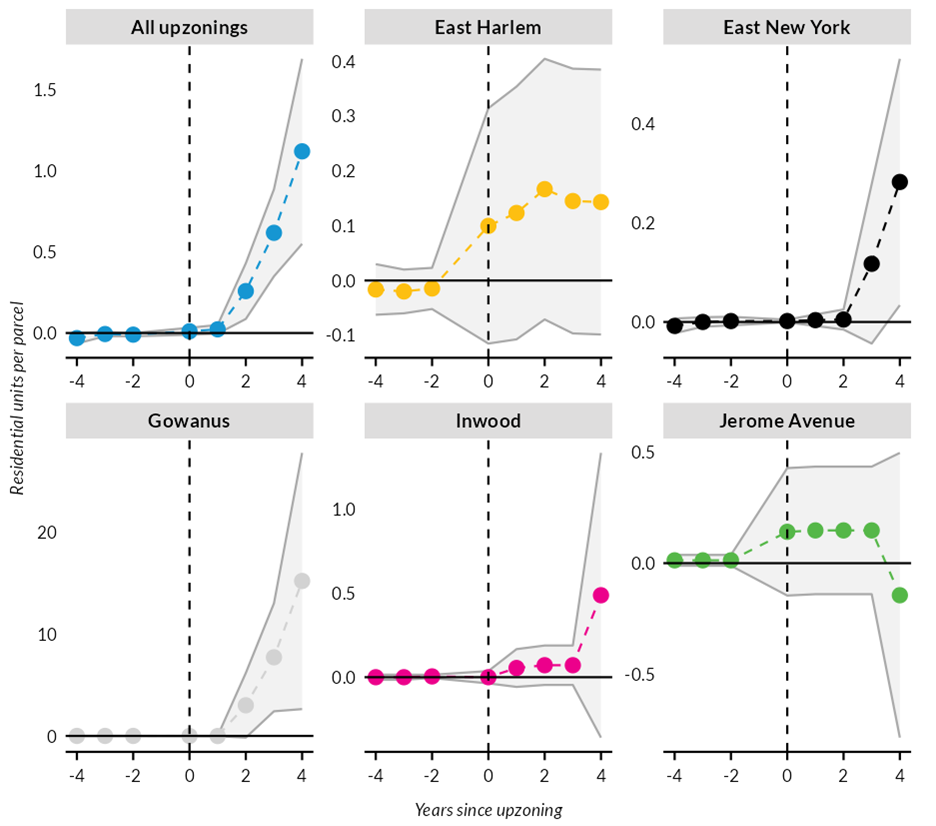
In New York, we estimate that seven neighborhood-scale upzonings collectively resulted in more than 4,000 additional housing units within four years compared with the number of added units on similar parcels that were not upzoned. More supply growth is likely in the upzoned areas in future years. Upzoning’s effects were particularly notable in the Gowanus, Brooklyn, neighborhood, where the transformation of formerly industrial land near relatively high-income neighborhoods made way for many market-rate homes and a large number of units specifically for households with low and moderate incomes.
Change in residential units pre- and post-upzoning, per upzoned parcel, compared with non-upzoned parcels; note that y-axis scales differ
Source: Authors’ analysis of parcel data from New York City.
Notes: The “All upzonings” plot includes upzoned parcels from each of the visualized neighborhoods plus upzoned parcels from Downtown Far Rockaway and SoHo/NoHo, which were also sites of neighborhood rezonings during the study period. Light gray fills represent the 95 percent confidence interval around each point estimate. The year at –1, or one year pre-upzoning, is the reference year for the regressions, and so no coefficient is calculated for this time period nor visualized here.
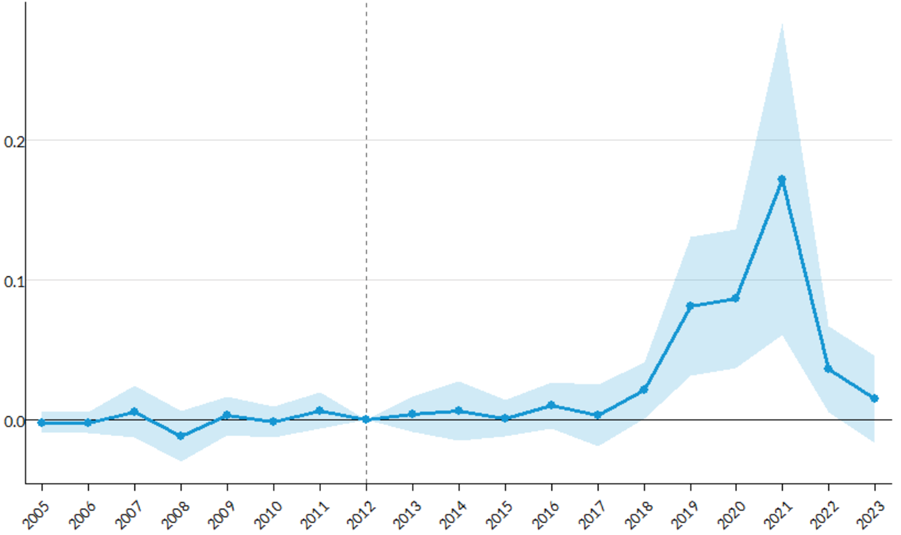
In Philadelphia, we find that the reform contributed to a meaningful increase in permitting citywide, especially during the period from 2019 to 2021. We estimate that upzoning helped generate a maximum of 4,000 additional housing unit permits per year citywide compared with non-upzoned areas, though there was substantial fluctuation over time, and many of those permits will not ultimately translate into construction.
Change in housing unit permit applications before and after 2012 zoning rewrite, per block face, compared with block faces that were not rezoned
Source: Authors’ analysis of permit data from Philadelphia Department of Licenses and Inspections and zoning data from Philadelphia City Planning Commission.
Notes: Light blue fill reflects the 95 percent confidence interval around each point estimate. Block faces are groups of adjacent parcels along the same city block that share similar characteristics and spatial proximity.
In Philadelphia, the upzonings concentrated development in larger projects. Although the Philadelphia upzonings increased the number of permitted units, they did not substantially increase the number of permitted projects. The upzonings likely increased the average number of units per development, especially in areas that were experiencing development pre-upzoning.
In both Philadelphia and New York, some areas did not see an increase in permitting or housing supply after upzoning, likely because of preexisting, weaker housing markets. We find that upzoning had significant effects on housing supply in many but not all of the upzoned New York City neighborhoods. The Jerome Avenue (Bronx) corridor showed no statistically significant change in housing supply compared with neighborhoods that were not upzoned. This area may have struggled to attract development because of its relatively weaker housing market; among the upzoned neighborhoods, it had the slowest pre-upzoning increase in rents. Similarly, despite the citywide nature of Philadelphia’s upzoning, we do not find evidence that the changes shifted where developers applied for permits; neighborhoods that had little demand before the rezoning did not attract a substantial share of new projects after rezoning.
How We Did It
Our aim was to understand how upzoning influenced housing supply in upzoned areas. To do so required comparing parcels (in New York City) and block faces (in Philadelphia) that were upzoned with parcels and block faces that were not upzoned, while controlling for other factors that might influence housing supply, such as pre-upzoning housing production and household income changes. We used propensity score matching to identify non-upzoned comparison units and then we ran difference-in-differences regressions to estimate the effects of the upzonings on housing supply.
